
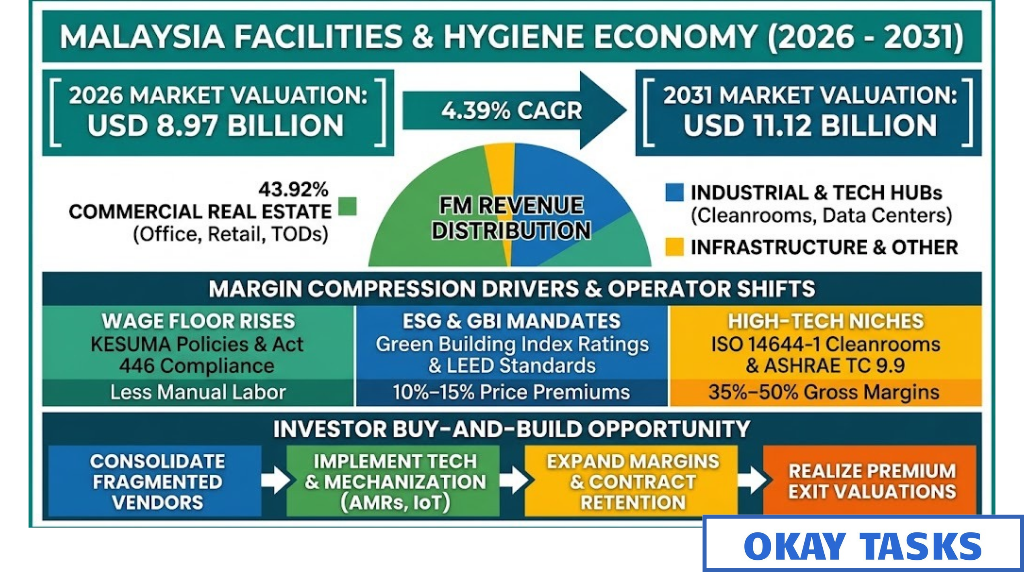
In institutional real estate, macro valuation shifts rarely happen overnight; they are driven by quiet, compounding operational fundamentals. Malaysia’s facility management (FM) landscape, anchored by commercial cleaning as its largest soft-services engine. is entering a decisive structural expansion.
Valued at USD 8.97 billion in 2026, the broader domestic FM sector is compounding at 4.39% annually to cross USD 11.12 billion by 2031. Rather than viewing this as a simple rising tide, institutional investors must analyze the underlying structural shifts reallocating market share toward high-efficiency operators.
1. Commercial Real Estate as the Primary Anchor
Commercial assets—including Grade-A office towers, integrated transit-oriented developments (TODs), mega-malls, and logistics parks—account for 43.92% of overall industry demand.In primary metros across Kuala Lumpur, Selangor, Johor, and Penang, prime commercial property yields are increasingly tied to tenant retention. For multinational tenants, facility sanitation is no longer an invisible line item—it is an audited operational requirement linked to employee wellness, workplace safety, and corporate governance.
2. Microeconomic Pressures Reshaping Operator Margins
The transition toward a USD 11.12 billion market size is accompanied by significant margin compression for legacy operators, driven by three core operational shifts:
A. The Death of Low-Cost Manual Labor
Policy updates enforced by the Ministry of Human Resources Malaysia (KESUMA)—alongside strict enforcement of worker housing standards under Act 446—have altered the cost structure of manual janitorial models. Operators that fail to mechanize face shrinking gross margins under rising wage floors.
B. ESG Mandates as a Pricing Mechanism
Commercial landlords pursuing local Green Building Index (GBI) Malaysia ratings or global LEED Certifications must meet strict indoor air quality (IAQ) and non-toxic chemical standards. Service providers equipped with eco-certified protocols, HEPA-filtered fleets, and automated dilution systems command 10% to 15% pricing premiums over uncertified competitors.
C. The Rise of High-Tech Technical Niches
Standard office maintenance yields modest operating margins. However, specialized sub-sectors—such as data center decontamination in Cyberjaya and Johor, or semiconductor cleanroom protocols meeting ISO 14644-1 Standards in Penang—command gross margins between 35% and 50%.
3. Opportunity for Investors
Because the Malaysian market remains fragmented among thousands of regional service vendors, it represents an ideal environment for private equity roll-up strategies:
- Margin Expansion via Mechanization: Replacing routine manual floor scrubbing with Autonomous Mobile Robots (AMRs) cuts direct labor hours, allowing operators to absorb wage increases while expanding EBITDA.
- Predictive IoT Deployment: Deploying foot-traffic sensors in commercial rest areas transitions contracts from fixed hourly schedules to demand-based deployments, reducing consumable waste and optimizing staff allocation.
- Contract Retention: Digitized proof-of-work reporting and verifiable audit trails reduce annual contract churn to under 5%, establishing predictable long-term cash flows.
The expansion of Malaysia’s facility services market to USD 11.12 billion by 2031 is not merely about physical growth—it is a story of market consolidation. Investors and service providers that deploy capital into tech-enabled operations, strict ESG compliance, and specialized industrial niches will capture disproportionate market share and achieve premium exit valuations.
Say Okay to Every Cleaning Task
Okay Tasks is the premier solution for residential and commercial cleaning in Malaysia. Whether it’s a last-minute on-demand request or a scheduled deep clean, the app connects you with verified vendors to ensure your space shines with professional excellence.