
The home care and residential service sector, encompassing everything from domestic cleaning to specialized home-based health services, has historically been viewed through the lens of hyper-local, “mom-and-pop” operations. However, as digital transformation accelerates across non-office environments, institutional capital is eyeing a clear market opening: Home Care Logistics.
Driven by shifting consumer behaviors, demographic tailwinds, and scalable technology, institutional allocators have a major opportunity to deploy capital into the operational backbone of home care.
Massive Fragmentation Meets ‘DIFM’ Demand
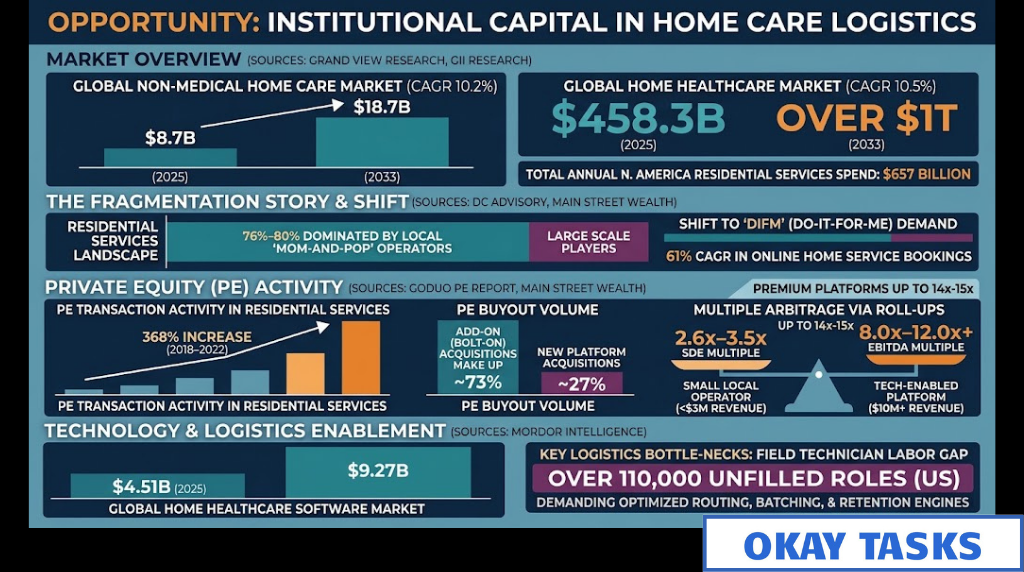
The market for home-based care and private household services is expanding rapidly. The global non-medical home care market reached $8.7 billion in 2025 and is projected to reach $18.7 billion by 2033 at a 10.2% CAGR, according to market analysis by Grand View Research. When combined with clinical home healthcare—projected to surge from $458.3 billion in 2025 to over $1 trillion by 2033 according to GII Research—the addressable market for last-mile residential delivery infrastructure is massive.
This growth trajectory is powered by two macro forces:
- The “Do-It-For-Me” (DIFM) Shift: Busy urban professionals and dual-income households increasingly prioritize convenience, moving away from traditional DIY home maintenance toward recurring subscription-based services. Online bookings across residential services have surged at a 61% CAGR in recent years.
- Extreme Fragmentation: Industry figures from DC Advisory show that between 76% and 80% of the residential service landscape remains dominated by local operators with fewer than 10 employees, severely lacking technological scale.
This dynamic mirrors the classic institutional roll-up playbook: consolidate a fragmented industry, deploy enterprise software, standardize service delivery, and capture margin expansion through scale.
Why Institutional Allocators Care About ‘Logistics’
The value in home care is no longer in simply placing workers—it lies in optimizing the last-mile logistics of labor and service fulfillment. Tech-enabled platforms that solve dispatch, routing, and capacity allocation convert a historically low-margin industry into a high-margin technology asset.
Key drivers catching the attention of Private Equity (PE) and Growth Equity include:
- Predictable Cash Flow Models: Through automated recurring scheduling (e.g., bi-weekly residential cleaning or continuous maintenance contracts), platforms generate high Net Revenue Retention (NRR) and predictable, subscription-like cash flows.
- Dynamic Route & Dispatch Optimization: Logistics software maximizes worker utilization rates, drastically reducing transit downtime and expanding gross operating margins.
- Supply-Side Retention Engine: In a tight labor market where field technician shortages account for over 110,000 unfilled roles, platform infrastructure offering streamlined scheduling, automated payout structures, and optimal route clustering improves worker retention—the primary bottleneck to scaling.
Strategic Entry Points for Capital Deployers
Institutional investors do not need to build from scratch; multiple entry points exist across the capital stack:
- Platform Roll-Ups & Multiple Arbitrage: Buying regional market leaders in high-density metropolitan areas and unifying them under a shared technology stack. According to Main Street Wealth M&A analysis, single local operators under $3M in revenue typically trade at modest multiples of 2.6x–3.5x SDE, whereas unified, tech-enabled regional platforms can scale to 8.0x–12.0x+ EBITDA multiples (with premium platforms commanding up to 14x–15x).
- B2B & Commercial Expansion: Leveraging consumer-facing residential infrastructure to capture high-margin, long-term commercial real estate and facility management contracts.
- SaaS & Infrastructure Layer: Investing directly in the software powering modern operators. Data from Mordor Intelligence estimates the field care software and logistics management market at $4.51 billion in 2025, expanding to $9.27 billion as platforms adopt smart dispatch, electronic visit verification (EVV), and route optimization.
Bottlenecks to Watch
Institutional entry into home care logistics is not without friction. Investors must underwrite risks associated with worker retention, quality control at scale, and unit-level Customer Acquisition Cost (CAC). Platforms that rely purely on paid acquisition without organic retention engines risk margin erosion.
Is there an opportunity for institutional capital in home care logistics? Unquestionably. The sector offers a rare combination of non-cyclical demand, defensive cash flows, and extreme operational inefficiency ripe for technology-driven consolidation. Investors who back the platforms building the underlying logistical rail will define the future of modern residential services.
Say Okay to Every Cleaning Task
Okay Tasks is the premier solution for residential and commercial cleaning in Malaysia. Whether it’s a last-minute on-demand request or a scheduled deep clean, the app connects you with verified vendors to ensure your space shines with professional excellence.