
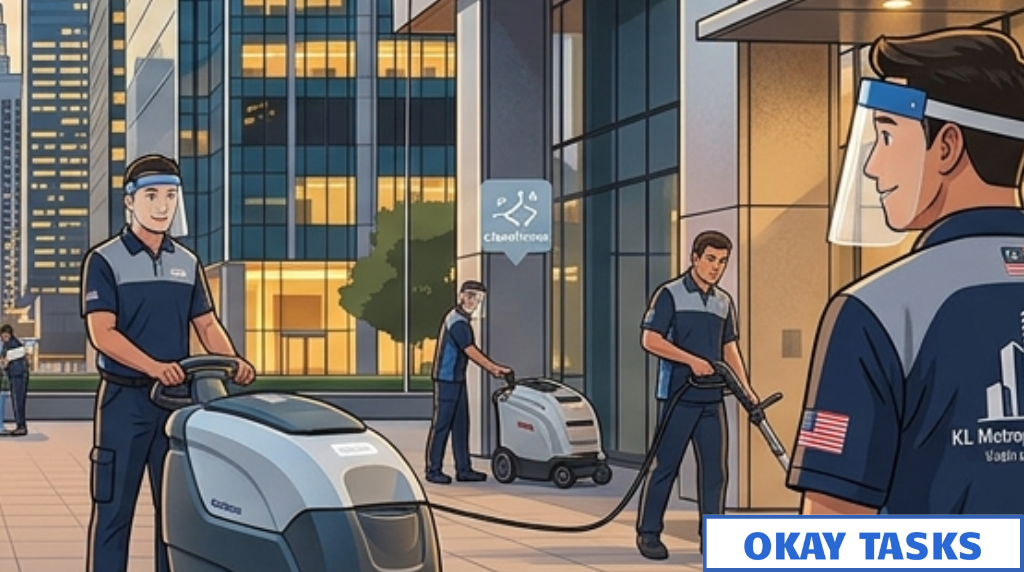
Rapid global urbanization is fundamentally altering how residential and commercial spaces operate. As metropolitan hubs expand and population densities concentrate in high-rise residential towers and dense commercial districts, traditional approaches to property maintenance are quickly becoming obsolete. What was once an informal, fragmented cottage industry is rapidly evolving into a technology-driven, on-demand utility.
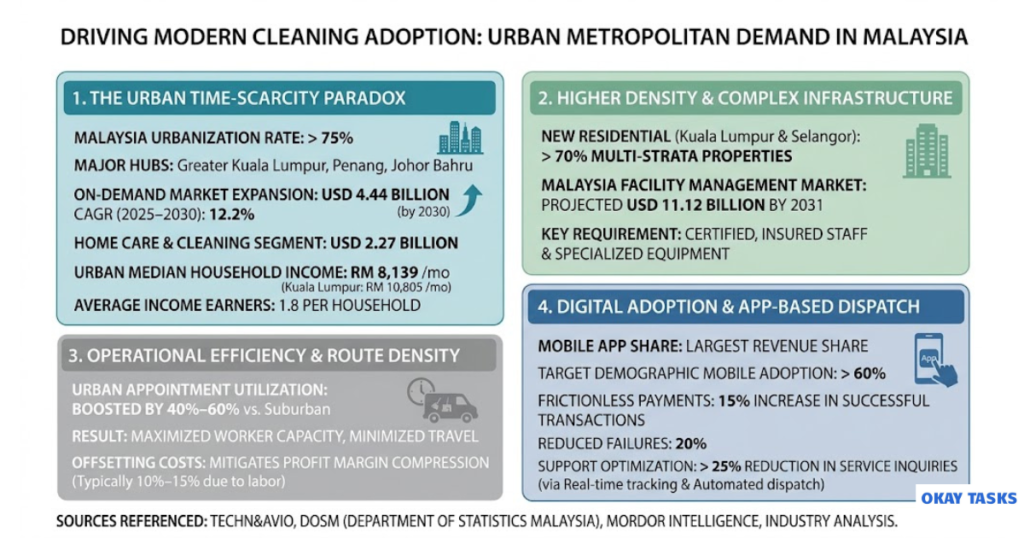
Growing metropolitan demand is the primary engine behind the widespread adoption of modern, tech-enabled cleaning services. In Malaysia, where the national urbanization rate exceeds 75%, this dynamic is particularly pronounced across major economic hubs like Greater Kuala Lumpur, Penang, and Johor Bahru.
1. The Urban Time-Scarcity Paradox
Metropolitan areas are populated by busy dual-income households and young professionals facing demanding schedules. In dense urban centers, time has become the ultimate luxury asset. As a result, the shift toward a “Do-It-For-Me” (DIFM) mindset is accelerating.
According to market intelligence from Technavio’s Malaysia Online On-demand Home Services Market Report, Malaysia’s market is expanding by USD 4.44 billion at a 12.2% CAGR (2025–2030). The home care and cleaning segment represents the dominant driver, valued at USD 2.27 billion.
This capital-for-time trade is supported by strong urban purchasing power. Data from the Department of Statistics Malaysia (DOSM) indicates that urban median household income reached RM8,139 per month (with Kuala Lumpur leading at RM10,805), driven by an average of 1.8 income earners per household. Urban residents are increasingly willing to delegate domestic chores to mobile-scheduled platform providers rather than managing them manually.
2. Higher Density and Complex Infrastructure
Urbanization has shifted living patterns from standalone suburban homes to multi-story condominiums, high-density apartment complexes, and mixed-use commercial developments. In Kuala Lumpur and Selangor, over 70% of new residential developments are multi-strata properties. These modern building environments introduce unique operational requirements:
- Strict Property Management Standards: Multi-family complexes and commercial hubs require background-checked, insured, and certified service staff rather than informal labor.
- Specialized Cleaning Protocols: High-traffic shared amenities, co-working spaces, and premium architectural surfaces demand eco-friendly formulations and specialized sanitation equipment.
According to Mordor Intelligence’s Malaysia Facility Management Analysis, Malaysia’s broader facilities and commercial property care market is projected to reach USD 11.12 billion by 2031, driven by structural shifts toward recurring subscriptions and specialized deep-cleaning packages in dense urban centers.
3. Operational Efficiency Through Route Density
For modern cleaning platforms, metropolitan density provides a massive logistical advantage. Servicing spread-out suburban neighborhoods involves significant transit downtime and fuel overhead. Conversely, an urban core allows cleaning platforms to achieve extreme route density.
Servicing high-density urban developments in Greater KL enables platforms to increase worker daily appointment utilization by 40%–60% compared to landed suburban neighborhoods. A single service crew can service multiple units within the same residential tower or commercial complex in a single day. This geographical concentration minimizes travel friction, increases worker capacity utilization, and helps operators offset general human capital cost increases that typically compress profit margins by 10%–15%.
4. Digital Adoption and App-Based Dispatch
Modern urban consumers expect seamless, instant digital interactions. Paper invoices and cash payments have given way to app-based scheduling, automated subscription billing, and real-time provider tracking.
Technavio’s industry insights highlight that mobile apps account for the largest revenue share in Malaysia’s home services market, backed by target demographic mobile adoption rates exceeding 60%. Key digital operational metrics show:
- Frictionless Payments: Integrated digital payment flows increase successful transaction completions by 15% and reduce payment failures by 20% compared to traditional manual billing.
- Support Optimization: Deploying real-time provider tracking and automated dispatch systems reduces customer service inquiries for local platforms by over 25%.
Metropolitan growth is doing far more than inflating total cleaning volume; it is standardizing how home services are ordered, scheduled, and fulfilled. As urban centers continue to swell, tech-enabled cleaning platforms that master localized route density and seamless digital booking will define the future of modern home care logistics.
Say Okay to Every Cleaning Task
Okay Tasks is the premier solution for residential and commercial cleaning in Malaysia. Whether it’s a last-minute on-demand request or a scheduled deep clean, the app connects you with verified vendors to ensure your space shines with professional excellence.