
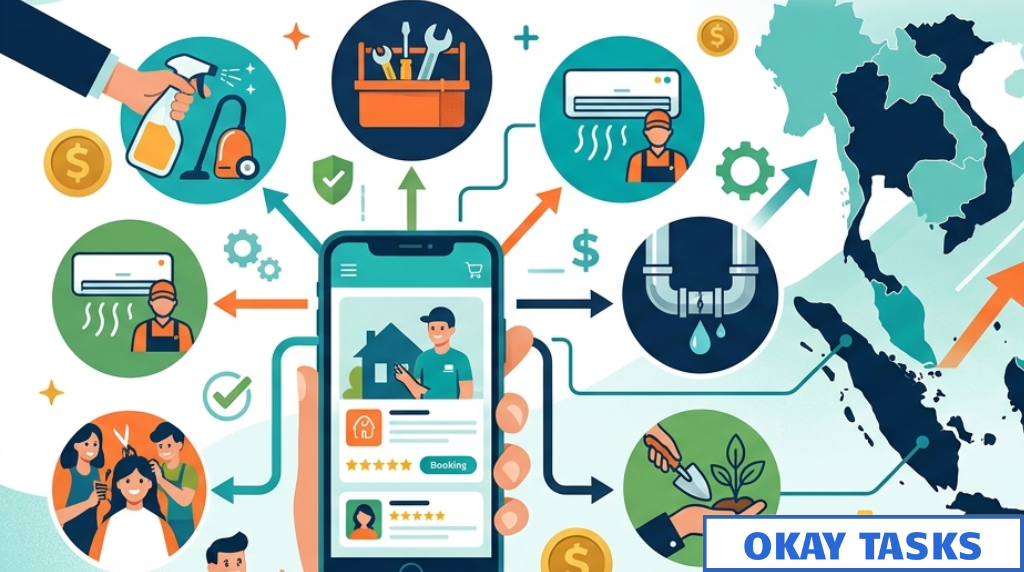
Southeast Asia’s digital economy has entered a phase of deep vertical maturation. While the previous decade was defined by the explosive rise of e-commerce, ride-hailing, and food delivery, macro-level consumer behavior has shifted toward the fragmentation of local offline services.
Urban centers across Singapore, Malaysia, Indonesia, and Thailand are experiencing a significant surge in the online on-demand home services market, which is projected to expand by over USD 26 billion through 2030, maintaining an accelerated compound annual growth rate (CAGR) of over 13%. This rapid growth marks a structural transition from an informal, word-of-mouth sector into a digitized, standardized marketplace.
Market Drivers: Urbanization and Changing Demographics
This profound market expansion is primarily driven by rapid urbanization and the steady growth of a tech-savvy, middle-class population. In dense economic zones like the Klang Valley, Bangkok, and Jakarta, the modern household dynamic has shifted significantly. Dual-income families and busy young professionals face growing time constraints, turning domestic maintenance from a weekend chore into an outsourced utility.
Simultaneously, pervasive mobile connectivity and unified digital payment systems have removed traditional friction points. Consumers now expect household services—ranging from basic deep cleaning and appliance maintenance to specialized plumbing and electrical repairs—to be available instantly, transparently, and via a single smartphone application.
The Shift Toward Trust and Standardization
Historically, the informal home services sector in Southeast Asia struggled with asymmetric information, unpredictable pricing, and a lack of quality control. The modern on-demand marketplace model directly solves these issues by formalizing the blue-collar gig economy.
Tech platforms have transitioned from simple listing directories into active curators of talent. By deploying advanced AI algorithms for real-time predictive matching, platforms seamlessly optimize geographic proximity, vendor ratings, and customer requirements. For consumers, this structural oversight addresses primary concerns around trust and physical security:
- Strict Background Checks: Document and screening protocols for all independent contractors.
- Standardized Pricing: Eliminates arbitrary overcharging through pre-determined in-app fee structures.
- Continuous Quality Control: Community-driven rating and review frameworks that incentivize high performance.
This formalization benefits workers as well. Location-based digital platforms provide Southeast Asia’s estimated millions of freelancers with flexible earning opportunities, financial inclusion through digital banking, and formal vocational training, effectively raising the standard of labor across the region.
Capitalizing on Local Digital Growth
In Malaysia, this market transformation is supported by national digitalization initiatives led by agencies like the Malaysia Digital Economy Corporation (MDEC). Emerging at the forefront of this localized movement is Okay Tasks, an innovative online-to-offline (O2O) marketplace established in 2023.
By focusing on strict quality assurance and advanced AI-driven dispatching, the Okay Tasks mobile app bridges the gap between urban demand and trusted local professionals. The platform’s strategic partnerships and asset-light architecture allow it to replicate its onboarding and service delivery model rapidly across secondary cities like Melaka, capturing a substantial share of the growing regional demand. As Southeast Asian consumers increasingly prioritize convenience and operational reliability, integrated platforms like Okay Tasks are well-positioned to redefine the future of household management.
Say Okay to Every Cleaning Task
Okay Tasks is the premier solution for residential and commercial cleaning in Malaysia. Whether it’s a last-minute on-demand request or a scheduled deep clean, the app connects you with verified vendors to ensure your space shines with professional excellence.